GYNAECOMASTY TREATMENT
What is gynaecomastia?
Gynaecomastia is a medical term for excessive breast development in men. This can be a result of hormonal changes (e.g. in puberty, middle age) and/or fat accumulation (e.g. if overweight). Hormonal imbalance due to the use of certain medications or certain conditions or diseases can also be the cause of breast formation in men. Finally, excessive alcohol and drug consumption are also common causes. Usually, gynaecomastia occurs on both sides of the breast but it can also occur unevenly, on the right or left side.
When will you benefit from gynaecomastia treatment?
Surgical treatment of gynaecomastia is usually chosen when one cannot immediately identify its cause and thus cannot find an alternative solution. People often opt for surgery because they are physically bothered by gynaecomastia but the procedure is mainly performed for aesthetic reasons.
Surgery is also usually performed only when gynaecomastia is permanent. Gynaecomastia can also occur in babies or teenagers during puberty but it is often transient. In that case, treatment is not necessary because the breast development is temporary and usually disappears spontaneously within two years.
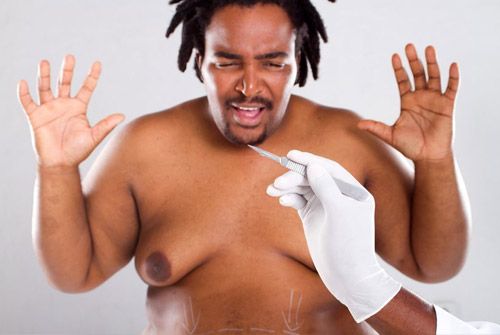
Before intervening surgically in gynaecomastia, the underlying causes are thoroughly investigated. The decision to proceed to surgery is made entirely in consultation with the patient after thoroughly informing them. The type of surgery is chosen depending on the circumstances and symptoms. Depending on the elasticity of the skin, liposculpture will be considered in combination with cutting away excess glandular tissue, similar to a breast reduction.
Usually, the surgical procedure for gynaecomastia is done under general anaesthesia and you will be hospitalised for a night. A compression bandage is also applied and removed after a week. The stitches are usually removed two weeks after surgery.
After the procedure, thin tubes are placed for 24 hours to drain fluid and prevent blood clots. After three days to a week, one can resume work, depending on the tasks one needs to perform. It is best to avoid strenuous activities for 2-3 weeks after treatment.
Complex complications are very rare with this procedure. However, bruising, irregularities or hardening of the scar may occur. Dr Lemmens closely monitors the healing process and any complication is immediately treated appropriately.